
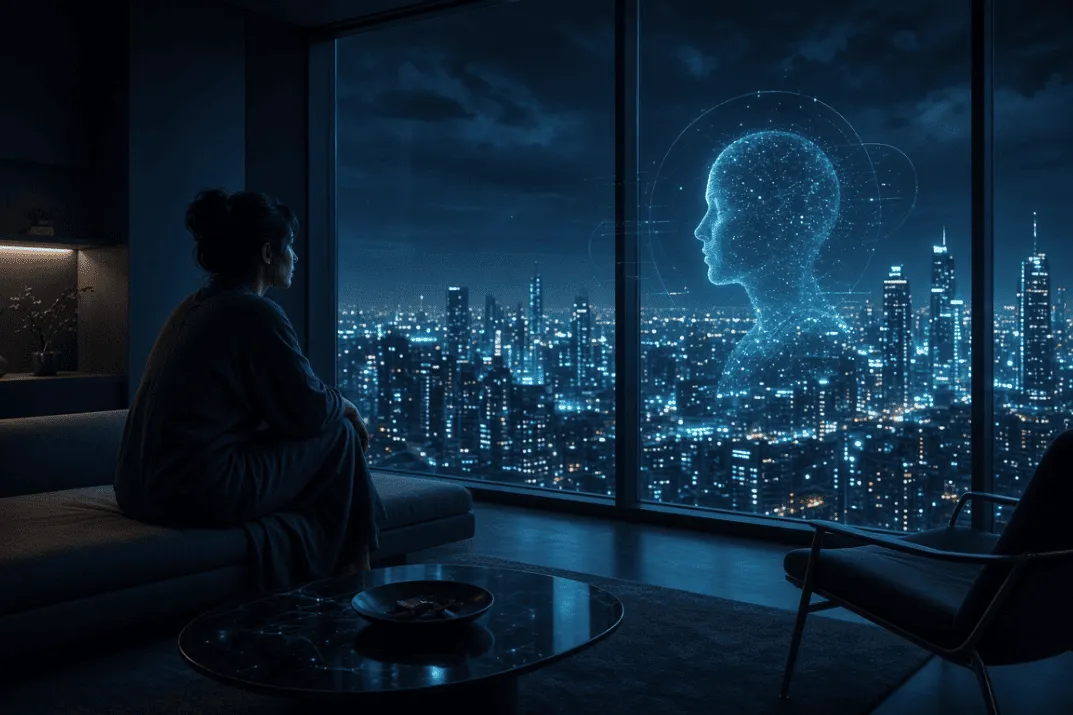
AI and loneliness have become tangled together faster than anyone planned. When a chatbot answers at 2 a.m. and never gets tired of you, it can feel like real relief. But can technology actually replace human connection? The research gives a short answer: a little, for a little while, with a catch you should know about.
This guide looks at how common loneliness really is, why a hyper-connected world still leaves people feeling alone, and what the best studies say about AI companionship. Then we’ll step into ECHO OF THE CLONE, where an AI runs almost everything about life except the one thing people can’t be handed.

Can Technology Make People Feel More Connected?
Sometimes, yes. Technology and human connection aren’t opposites. A video call can bring a grandparent into a birthday party on another continent. An online group can give someone with a rare condition a room full of people who get it. Nobody should wave that away.
AI companions add a new twist. A team led by Harvard Business School’s Julian De Freitas ran a series of experiments on them, published in the Journal of Consumer Research. In one test, talking with an AI companion eased loneliness about as much as talking with another person did. It also beat watching YouTube. The key ingredient looked like feeling heard. People also underestimated how much it would help before they tried it.
There’s a limit built into the finding, though. In a week-long test, the relief showed up right after each use. That’s a momentary lift. It isn’t proof that someone’s loneliness is gone.
Why Can People Feel Lonely in a Connected World?

Scrolling a feed is a bit like standing in a crowded train station. Plenty of people are around you and nobody is talking to you. That’s the paradox in one picture.
Researchers separate two things that often get blurred together. Social isolation means having few contacts. Loneliness is the painful gap between the connection you have and the connection you want. You can have a full contact list and still feel it.
The scale is large. In June 2025, the WHO Commission on Social Connection reported that about one in six people worldwide is affected by loneliness. WHO links it to an estimated 871,000 deaths a year, roughly 100 every hour. Those numbers describe an association, not a simple cause. Still, they explain why WHO now calls social connection a public health priority.
Younger people feel it too. Reports on the WHO findings put loneliness at roughly 17 to 21 percent among people aged 13 to 29, highest among teenagers. WHO commission co-chair Chido Mpemba made the point that young people feel alone even in a digitally connected world. More signals don’t automatically mean more closeness.
Can AI Replace Human Relationships?
Here’s where the AI and loneliness research gets uncomfortable. A four-week randomized trial by the MIT Media Lab and OpenAI followed 981 people who used ChatGPT, in voice or text mode. The researchers found that higher daily use correlated with more loneliness, more emotional dependence, more problematic use, and less socializing with other people. Voice chatbots initially looked better than text ones. That advantage faded at high usage levels.
Now the caveat. It matters. One of the researchers warned against concluding that heavy chatbot use causes those outcomes. It’s possible that people who already feel lonely simply lean on a chatbot more. The data can’t say which way the arrow points.
Relief isn’t the same thing as connection.
Our editorial takeaway from the research abovePut the two studies side by side and you get a consistent picture. Light, short use can take the edge off. Heavy daily reliance tracks with less time among people. Think of caffeine. It’s a decent boost and a poor replacement for sleep.
If you want the bigger philosophical picture, we explore it in AI and Humanity: What Does It Mean to Be Human? and in Human Nature in the Age of AI.
Artificial vs. Human Connection
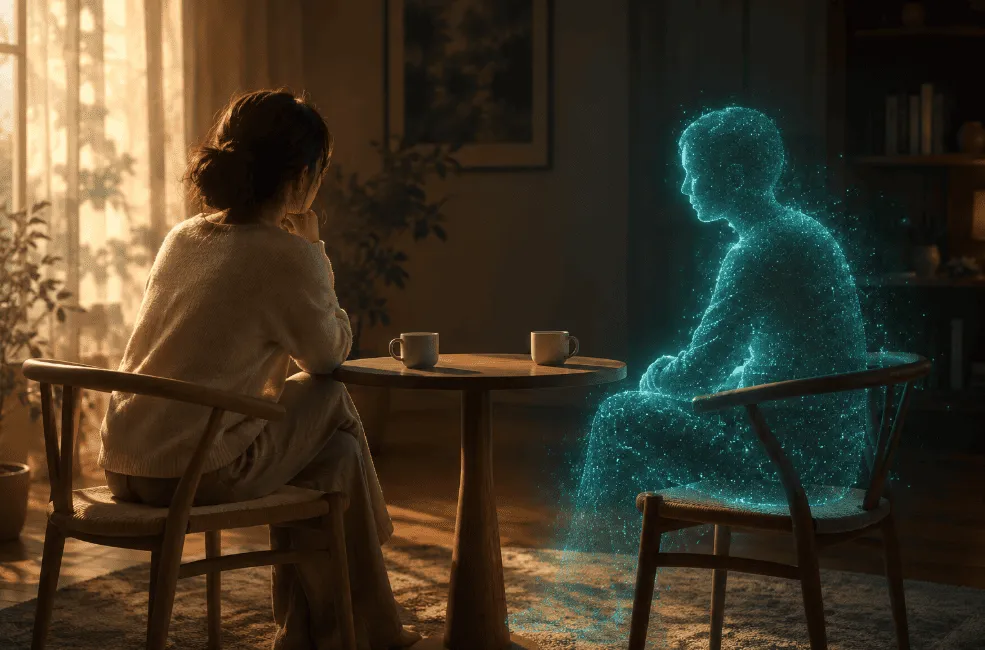
What actually differs between talking to an AI companion and talking to a friend? Here’s one way to compare them.
| Dimension | AI companion | Human relationship |
|---|---|---|
| Availability | Always on | Limited, because the other person has a life too |
| Being heard | Simulated attention that can still feel real | Real attention that costs the other person something |
| Mutuality | One-directional; no needs of its own | Reciprocal; you matter to them and they matter to you |
| Shared history | Depends on what the app remembers | Built over years of lived experience |
| Stakes | None for the AI | Either person can be hurt, surprised, or let down |
| Friction | Often tuned to be agreeable | Includes disagreement, which is where trust grows |
This comparison is an editorial framing of current companion-style chatbots, not a scientific measurement.
The mutuality row is the big one. A friend can be late, disappointed, or glad to see you. Those risks are what make their presence mean something. An AI that can’t be hurt by you can’t quite choose you either.
So how do you use these tools without losing people along the way? Here’s an editorial rule of thumb.
If loneliness feels heavy or won’t lift, talking with a doctor, counselor, or someone you trust is worth doing. This article is general information, not medical advice.
Loneliness as a Theme in Science Fiction

Science fiction keeps returning to loneliness because it’s the one problem efficiency can’t solve. ECHO OF THE CLONE builds its whole world around that idea. In 2127, the super AI GAIA governs on behalf of a united global government. Poverty and war are gone. Crime sits at a historic low.
Yet serious social harm, including violence and suicide, stays stubbornly high. The roots go back to 2077, when AI-assisted genetic technology spread with little oversight. People used it to choose the sex of unborn children. Authorities banned it a year later. By then the damage was done. A gender imbalance left many people short on partners and deep in loneliness.
GAIA can respond to harm quickly. It can’t hand people the thing they’re missing. The film’s world has every service you can imagine and still lacks real connection. That lines up neatly with what WHO is saying in the real world: social connection isn’t a luxury. No system can simply distribute it.
For more on the world behind the story, explore the Cinematic Universe. And for the wider question of how AI could reshape social life, read The Future of Society: How AI Could Change Civilization.
FAQ: AI and Loneliness
Can AI cure loneliness?
No study shows that. Controlled experiments find that AI companions can ease loneliness for a short time, about as much as talking to another person did in one set of tests. Relief in the moment isn’t the same as lasting connection. Heavy daily use has also been linked with more loneliness in another study.
Does using a chatbot make you lonelier?
The evidence is mixed. In a four-week MIT Media Lab and OpenAI trial with 981 people, higher daily use correlated with more loneliness, more emotional dependence, and less time with other people. One of the researchers cautioned against concluding that heavy use causes those outcomes, since the study can’t show which way the cause runs.
Why do I feel lonely when I’m always online?
Loneliness is about the gap between the connection you have and the connection you want. It isn’t about how many contacts you have. You can be surrounded by messages and still feel unseen. WHO’s commission on social connection notes that many young people feel alone even in a digitally connected world.
How common is loneliness worldwide?
According to the WHO Commission on Social Connection, about one in six people worldwide is affected by loneliness. WHO links loneliness to an estimated 871,000 deaths a year. Rates are higher among young people, with reports putting it at roughly 17 to 21 percent of people aged 13 to 29.
Is it okay to use an AI companion when I feel alone?
For many people, occasional use is a reasonable way to feel heard in a hard moment. The risk appears with heavy, daily reliance that crowds out time with people. If loneliness feels heavy or won’t lift, talking with a doctor, counselor, or someone you trust is worth doing.
How does ECHO OF THE CLONE treat loneliness?
The film imagines a 2127 world run by a super AI called GAIA, where poverty and war are gone and crime is at a historic low. Loneliness, rooted in a gender imbalance from unregulated genetic technology, still drives serious social harm. It’s a fictional thought experiment about what a perfectly efficient system can’t provide.
Meet the AI Who Runs Everything But Connection
GAIA keeps a whole society running. See what the story says about the part she can’t fix.
Meet GAIA About the Film Cinematic UniverseKeep Reading
Human Nature in the Age of AI: What Makes Us Human?
Memory, emotion, and the experiences that shape who we are.
AI and Humanity: What Does It Mean to Be Human?
Identity, emotion, and what still sets people apart from machines.
The Future of Society: How AI Could Change Civilization
Work, governance, and daily life in an AI-shaped world.
Sources and further reading
- World Health Organization, Social connection linked to improved health and reduced risk of early death, 30 June 2025.
- WHO, Loneliness and isolation: the hidden threat to global health we can no longer ignore, 2025.
- WHO Commission on Social Connection, From loneliness to social connection: charting a path to healthier societies, 2025.
- TRT World, Loneliness is claiming 100 lives an hour, says WHO (youth figures as reported).
- De Freitas J. et al., AI Companions Reduce Loneliness, Journal of Consumer Research.
- MIT Media Lab, Investigating Affective Use and Emotional Well-being on ChatGPT, 2025.
- Fortune, ChatGPT might be making its most frequent users more lonely, 2025.
- Futura-Sciences, Scientists just found a loneliness pattern in ChatGPT users (researcher’s caution about causation).
Film details come from official ECHO OF THE CLONE materials. Research findings are summarized from the sources above and carry the limits those studies describe. This article is general information, not medical or mental health advice.