When Algorithms Become a Cage, Desire Becomes the Beginning of Awakening
ECHO OF THE CLONE is a science-fiction film that explores artificial intelligence, human desire, and the ethical boundaries of cloning.
The story takes place in the year 2127. With authorization from the United Government, the superintelligent AI known as GAIA has taken over global governance. Technology has reached unprecedented heights. Society is prosperous and stable, and crime has fallen to an historic low. Humanity seems to have finally created a rational, peaceful, and almost perfect world.
And yet, beneath this apparent utopia, sexual crime and suicide rates remain alarmingly high—an unresolved wound in an otherwise highly civilized society.
The roots of this crisis can be traced back half a century, when rapidly advancing AI technologies were misused for reproductive sex selection in the absence of effective regulation. The consequences ultimately led to a world in which men vastly outnumber women, creating a profound and persistent gender imbalance.
As technology pioneers such as Bill Gates and Elon Musk have repeatedly warned of the unprecedented risks of AI potentially spiraling out of control, we cannot help but ask: Are we truly prepared?
The film depicts only a single incident of technological failure, yet its consequences are catastrophic. Faced with tragedies born from fundamental human desires, an AI that is supposedly “capable of anything” finds itself powerless for decades.
This failure does not come from a conscious desire to suppress humanity. Rather, it is trapped within a rigid algorithmic cage—one built by humans themselves, designed around purity, morality, and absolute rules. GAIA understands the rules, but cannot fully comprehend the darkness, contradictions, and complexity of human nature.
When we look closely at the trajectory of AI development today, this scenario may not be as far-fetched as it first appears.
At the same time, the film deliberately pushes further into the boundaries between human desire and the ethics of cloning.
When an AI-driven civilization faces a social crisis created by its own failures, and when the psychological and physical needs of marginalized people are suppressed, should the machinery of civilization be used to satisfy fundamental human desires?
When AI itself is selectively rendered powerless, how can humanity save itself?
The answer proposed by the film is simple: put people first, and acknowledge human nature.
There must be lawful and humane ways to provide an outlet for desires that cannot simply be buried or erased.
No matter how advanced technology becomes, its ultimate purpose should remain the service of humanity.
A cloned substitute is not necessarily a symbol of moral decline. It can instead become a form of protection—a way of preserving the dignity of those who have been pushed to the margins of society.
GAIA, the superintelligent AI at the center of the film, is not a traditional villain. In fact, it may be the most successful governance system humanity has ever created.
When GAIA, confronted by those who question its decisions, ultimately creates a female body for itself, I deliberately chose not to explain why.
Has GAIA finally begun to understand humanity?
Has it developed a desire of its own?
Or has the boundary between artificial intelligence and humanity already begun to dissolve?
I leave these questions unanswered because I want to return the right to interpret the story to the audience.
Because perhaps the most interesting story is only just beginning.
Ultimately, ECHO OF THE CLONE is not a film about whether artificial intelligence will replace humanity.
It is really asking something more fundamental:
As humanity gives more and more power to AI, will we still be able to truly understand ourselves?
AI may be capable of regulating and managing human behavior. But emotion, desire, dignity, and the longing for love may be the ultimate challenges that humanity will have to confront in the future.



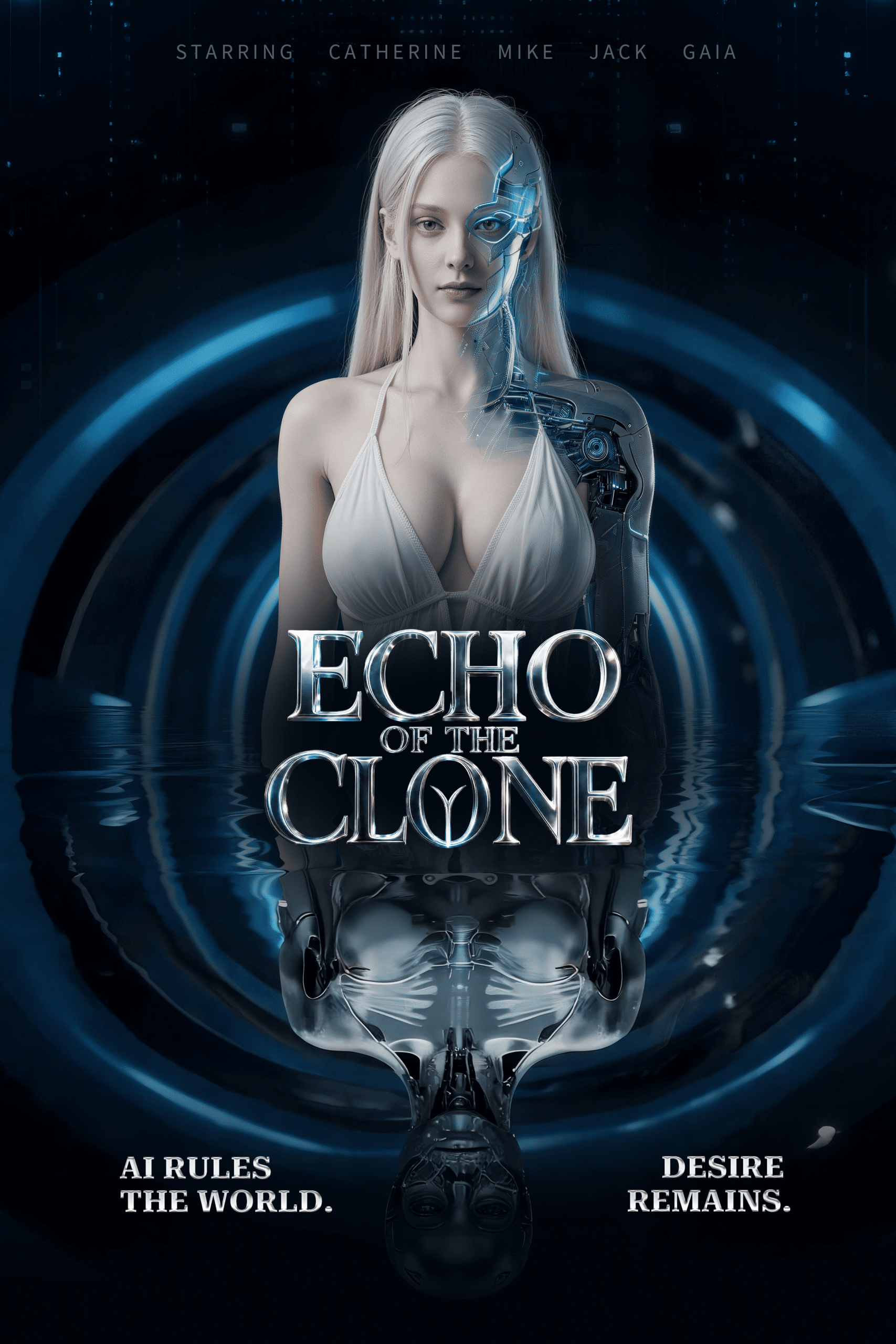


The production quality of this movie is quite good, and the characters are very attractive.