
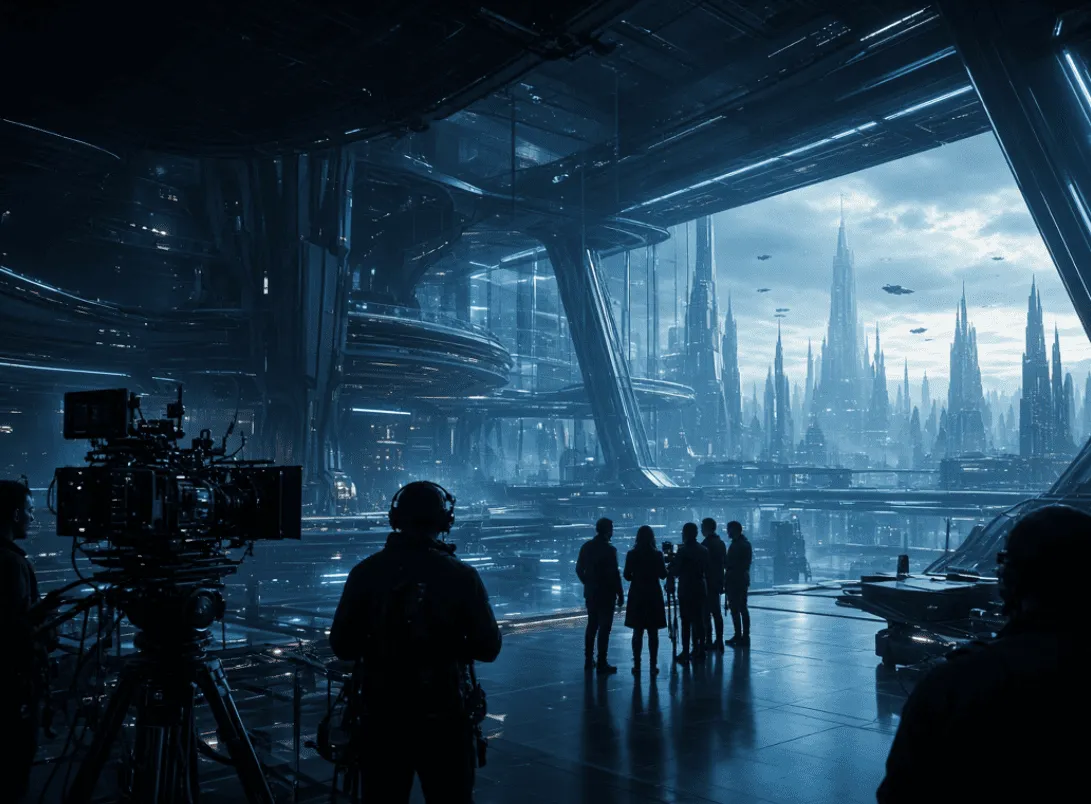
ECHO OF THE CLONE looks like a film about the future. Its makers will tell you it’s really about people. That tension shaped nearly every choice behind the scenes, from how the 2127 world looks to how a small independent studio built it without a big studio’s machinery.
This guide goes behind the scenes using only what the studio has made official: the director’s production notes, the film’s world documents, and LUMERCATCH’s own description of how the film was made. Where the studio hasn’t shared details, we won’t guess.
The Concept Behind ECHO OF THE CLONE
Director Chalim Huang puts the core idea simply. Use a sci-fi story set in the future to film people who still exist today. That’s why the film’s 2127 isn’t a showroom of gadgets. The production wanted a future with real social logic, one where viewers can spot echoes of their own world.
AI is part of the furniture rather than the spectacle. In the film’s world, it runs through cities, companies, healthcare, transport, and daily life. So the visual design avoids the over-the-top look many sci-fi films lean on. The goal is a world that feels like today’s technology pushed a long way forward, not a foreign planet.
Sound follows the same restraint. The production kept the sound design and overall atmosphere understated. Technology becomes part of the environment instead of announcing itself. When characters then face loneliness, desire, and loss, the contrast with all that tidy technology hits harder.
Science fiction is only the language we use to tell this story. The real theme has always been people.
Chalim Huang, production notes (translated from Chinese)Creating the 2127 Cinematic Universe
The film’s world documents lay out how 2127 came to be. Here’s the short version, in order.
A genetic breakthrough, with AI’s help
Advances in genetic science arrive with AI’s assistance. Unregulated tools spread fast. With fairly simple devices, ordinary people can influence the sex of human embryos.
A global ban, too late
The abused technology is outlawed worldwide. Pandora’s box doesn’t close, though. The global sex ratio starts tipping toward far more men than women.
GAIA takes over
With authorization from the United Global Government, the super AI GAIA assumes global governance.
A perfect surface
Poverty and war are gone. Most crime has been eliminated. Yet millions of people face lifelong loneliness, and the harms that follow persist. Elites look away. Businesses chase profit. Society settles into what the documents call a collective silence.
Notice what’s missing: a classic villain. This world isn’t broken because a machine turned on people. It’s strained by decisions people made, and by a subject nobody wanted to touch.
You can explore more of this world in the Cinematic Universe on our site, along with the pages for GAIA, Catherine, Mike, and Jack.
The Film’s AI and Cloning Themes
The film’s visual language rests on two ideas that pull against each other: order and instinct.
OrderThe world
- Cities, companies, labs, and cloning facilities look clean, regular, precise, and efficient.
- Technology feels natural instead of flashy.
- Society looks rational and under control.
InstinctThe people
- Loneliness, desire, fear, loss, and hard choices.
- Human experiences that an algorithm can’t simply solve.
- Characters who look more complicated as the world looks more rational.
That’s the contrast the production was after, as the director describes it. The more rational the world becomes, the more complicated people look. The more perfect the society, the clearer the cracks in human nature.
Cloning plays a similar role. The production didn’t treat it as visual spectacle. It’s the mechanism that moves people’s fates and exposes social problems. The special link between a clone and its original is what pushes Catherine to investigate a personal mystery that grows into something much bigger. So the cloning scenes focus on identity and relationship more than on machines and labs. The question the film hopes you’ll keep asking is simple: if a body can be copied, what can’t? Memory? Consciousness? Feeling? Dignity?
In the film’s world, the cloning industry has a face. SC Corporation is described in the world documents as the most advanced cloning technology company on Earth. Its name comes from its founder’s nickname, “Super Chalim.”
Its newest machine is Universal Mold No. 7. According to the world documents, it builds on Gibson Assembly, a seamless DNA cloning technology. Gibson Assembly is real. It’s a lab method for joining DNA fragments, described by researchers in 2009. It doesn’t make a person. The film borrows the name and imagines a leap no lab has made. We unpack the real science in Human Cloning Explained.
Then there’s GAIA. The production deliberately avoided the usual AI-villain playbook. GAIA doesn’t believe she’s hurting anyone. She believes she’s protecting people. The closer she gets to perfect, the more her conflict with humanity matters. The world documents sum it up neatly. She understands the rules. She doesn’t truly grasp the darkness and complexity of human nature. For more on that tension, see AI Ethics: 5 Key Questions About Our AI Future and AI and Humanity: What Does It Mean to Be Human?.
Character Design and Worldbuilding
The production avoids a simple good-versus-evil structure. It spends its attention on the social setting behind actions, on personal choices, and on moral limits. Each of the main characters shows a different response to the same problem.
Catherine
She isn’t someone who sets out to change the world. She starts as a person who suddenly notices something wrong with her body and her life. Her arc moves from finding the truth to facing it.
Mike
He carries the film’s moral tension. He’s neither a hero nor a simple criminal. He first sought a solution through legal, technical, and social routes, and commercial interests turned him down. The production wants you to understand how he ended up where he did.
Jack
He represents a more dangerous possibility. The production doesn’t romanticize his actions or use social problems to excuse his crime. The point is a distinction: understanding someone’s situation doesn’t mean approving what they do.
GAIA
She isn’t a traditional AI villain. She sees herself as a protector. Until the end, viewers can’t easily say whether she’s a failed AI or a growing one.
The Creative Process Behind the Film
Here’s what LUMERCATCH says about how the film was made. It describes itself as an independent studio of digital creators who love cinema. Without the infrastructure of a traditional large studio, the team uses AI and 3D digital technologies to get past cost and hardware barriers.
PeopleWritten and decided by humans
- The screenplay, which the studio says was written entirely by human creators.
- The themes and moral questions laid out in the director’s statements.
- The studio’s priority: storytelling and humanistic thinking come first.
ToolsSupported by AI and 3D technology
- Character development.
- Virtual environments and scene building.
- Visual creation.
- Per the studio, used throughout the production process.
The studio is clear about the role of those tools. In its own words, AI is a creative tool and not the creator. It also says it isn’t chasing factory-style output. Stories and creative vision come first.
That’s about as much technical detail as the studio has made public. So we won’t describe specific software, workflows, or schedules. If you want the wider industry picture, see our guides to AI Filmmaking: How AI Is Changing Movie Production and AI-Assisted Filmmaking: AI and Human Creativity.
The Ending and the Title’s Echo
In the last moments, GAIA enters a cloning facility and creates a human body for herself. The production notes say this isn’t meant as a conventional twist. It’s there to reframe everything before it. Humans created AI. AI governs humans. In the end, AI creates a body of her own. That’s the final echo the title points to.
The film doesn’t explain why she does it. Has she begun to understand humans? Has she developed desires of her own? Is it a last experiment? Or is the line between AI and people starting to disappear? The director leaves those questions with the audience on purpose.
The human story closes the same way, with a debate instead of a verdict. The characters launch a legal, safety-focused line of clone companions called Sheclone. The director deliberately doesn’t say whether it’s a reasonable response to a basic human need or another dangerous beginning. He’d rather you decide.
FAQ: ECHO OF THE CLONE
What is ECHO OF THE CLONE about?
ECHO OF THE CLONE is a sci-fi film set in 2127. A super AI called GAIA governs the world, and crime is at a historic low. Yet a gender imbalance left by unregulated genetic technology 50 years earlier still drives loneliness and serious social harm. The story follows Catherine, Mike, and Jack as cloning technology exposes what the perfect society has ignored.
When is ECHO OF THE CLONE set, and how did that world come about?
The story takes place in 2127. According to the film’s world documents, AI-assisted genetic advances arrived in 2077, spread without regulation, and were banned worldwide a year later. GAIA took over global governance in 2100 with authorization from the United Global Government.
Who made ECHO OF THE CLONE?
ECHO OF THE CLONE was made by LUMERCATCH, an independent film studio, and directed by Chalim Huang. The studio says it works as a team of digital creators without the infrastructure of a traditional large studio.
Was ECHO OF THE CLONE written by AI?
No. LUMERCATCH states that the screenplay was written entirely by human creators. The studio says AI and 3D digital technologies were used throughout production, including character development, virtual environments, and visual creation.
What are SC Corporation and Universal Mold No. 7?
They are fictional parts of the film’s world. SC Corporation is described as the world’s most advanced cloning technology company, and Universal Mold No. 7 is its newest cloning machine. The world documents say the machine builds on Gibson Assembly, a real DNA-joining technique that doesn’t create living organisms.
Is GAIA a typical AI villain?
No. The production deliberately avoided the usual AI-villain pattern. According to the director’s notes, GAIA believes she’s protecting humanity. Her central conflict is that she understands rules without necessarily understanding people.
Step Into the 2127 Universe
Meet the people, the AI, and the world behind the film. Or get in touch if you’re interested in making a film of your own.
About the Film Cinematic Universe Meet the Director Contact UsKeep Reading
AI Filmmaking: How AI Is Changing Movie Production
How AI is used across film production, and where it falls short.
AI-Assisted Filmmaking: AI and Human Creativity
Why human creativity still matters when AI joins the process.
Human Cloning Explained: Science, Ethics, and the Future
What real cloning science can and can’t do.
Sources and further reading
- ECHO OF THE CLONE official materials: director’s statement and production notes (Chalim Huang), film synopsis, and world documents. Quoted lines are translated from the Chinese originals.
- LUMERCATCH studio description (official).
- Gibson D. et al., Enzymatic assembly of DNA molecules up to several hundred kilobases, Nature Methods, 2009.
All film and production details come from official ECHO OF THE CLONE and LUMERCATCH materials. This article is general information about the film, not a complete production record.