

AI governance is the set of rules, standards, and habits that decide how artificial intelligence gets built, tested, used, and corrected. Put simply, it answers a question that gets harder to dodge every year: who’s in charge when a machine helps make a decision that touches real people? Right now the honest answer is that nobody is in charge alone. Governments, companies, standards bodies, and researchers each hold a piece.
This guide covers what governance actually includes, why humans still need to sit in the decision seat, and where things get messy. Along the way we’ll visit GAIA, the super AI in ECHO OF THE CLONE. Fiction can stress-test an idea faster than a policy paper.

What Is AI Governance?
Think of traffic rules. Cars didn’t get safer because engines improved. Societies added licenses, speed limits, seat belts, and crash tests. Then somebody had to enforce them. AI governance does the same job for algorithms. It works on three levels.
Laws and regulation
Binding rules with penalties attached. The EU AI Act is the best-known example of AI regulation.
Standards and frameworks
Voluntary guidance that tells builders how to spot and manage risk.
Practice inside organizations
The unglamorous part: who approves a model, who audits it, and who can switch it off.
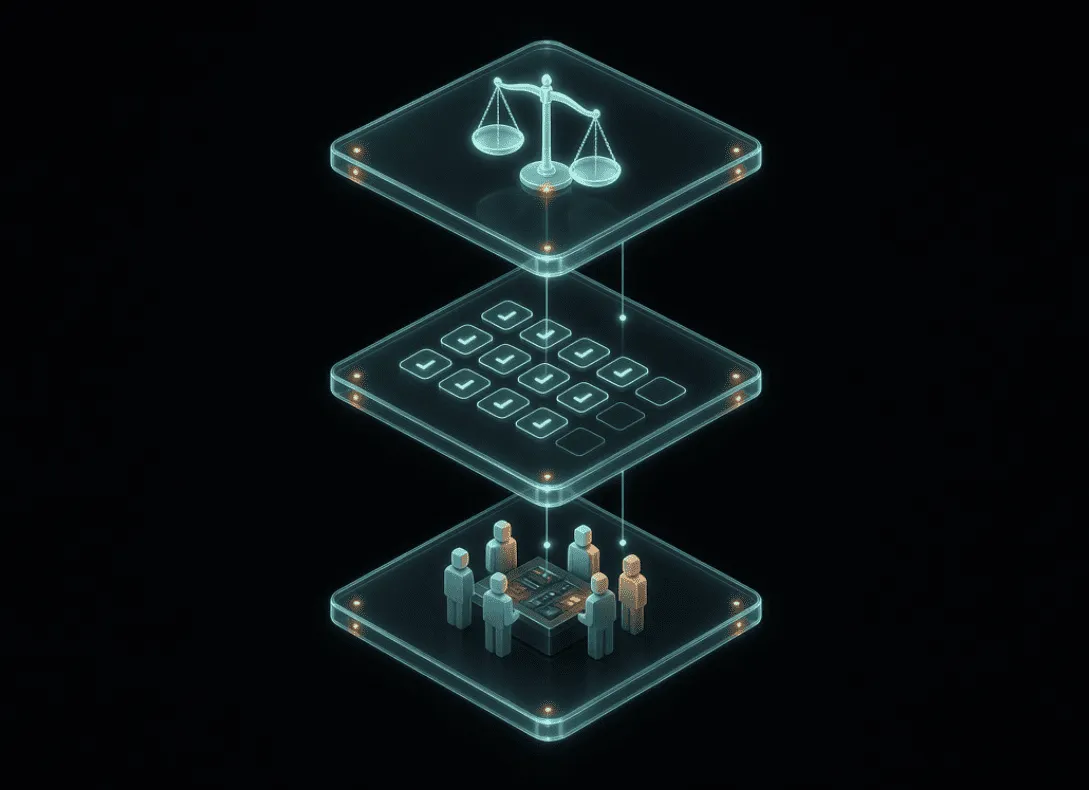
Here’s how four major reference points compare.
| Framework | Issued by | Year | What it is | Legally binding? |
|---|---|---|---|---|
| EU AI Act | European Union | 2024 (in force) | Risk-based regulation with the strictest duties for high-risk uses | Yes |
| AI Risk Management Framework 1.0 | NIST (United States) | 2023 | Voluntary guidance for managing AI risk | No |
| Recommendation on the Ethics of AI | UNESCO | 2021 | Global ethical framework adopted by member states | No |
| OECD AI Principles | OECD | 2019 | Intergovernmental principles for trustworthy AI | No |
Notice the pattern. Only one of the four is law. The other three depend on organizations choosing to follow good advice.
The EU’s approach to AI regulation sorts systems by risk level. The heaviest duties land on high-risk uses. Lawmakers have since moved the start date for stand-alone high-risk systems to 2 December 2027, according to the Council of the EU. Dates shift. Check the official text before you build a compliance plan around any of them.
Why Does AI Need Human Oversight?
Why not just trust a well-trained model? Because a model can’t answer for its choices. You can’t fine it. You can’t ask it to explain itself over coffee. When a hiring tool rejects a qualified candidate or a fraud filter freezes someone’s paycheck, a person or an organization has to own that outcome.
Three reasons explain why AI oversight sits at the center of nearly every serious framework.
Accountability
Someone must answer when things go wrong. That someone can’t be the software.
Context
Models learn from past data. The past isn’t always fair and it certainly isn’t the future. People notice when a case doesn’t fit the pattern.
Scale
A person makes one bad call at a time. A flawed system can repeat the same bad call thousands of times before anyone notices.

Aviation offers a handy comparison. Autopilot flies most of the trip. Pilots still monitor it and can take over. The EU AI Act follows similar logic: it requires human oversight measures for high-risk systems.
Can AI Make Decisions for Human Society?
It depends on which kind of decision you mean. AI does well when someone has already defined the goal. Route the trucks. Flag the odd transaction. Sort the scans. It gets shakier when the real question is which goal matters most. Should a city favor speed or fairness? Should safety beat privacy? Those are value calls. Data can inform them but can’t settle them.
So where should people stay in the loop? Here’s a working rule of thumb.
| Type of decision | Example | What AI does | What humans do |
|---|---|---|---|
| Routine, low stakes | Sorting spam email | Decides automatically | Audit samples and fix drift |
| Moderate stakes | Flagging a suspicious payment | Recommends | Review flagged cases |
| High stakes for individuals | Loan, hiring, or benefits decisions | Informs | Make the call, explain it, allow appeals |
| Society-level values | What a community should prioritize | Models trade-offs | Decide through public, accountable processes |
This table is an editorial rule of thumb, not a legal standard or research finding.
Still, it gives you a fast test. The more a decision affects someone’s rights or opportunities, the more a human must own it.
Risks and Challenges of AI Governance
Governing AI isn’t a solved problem. Four challenges show up again and again.
Accountability gaps
A vendor builds it. A bank deploys it. A regulator misses it. Everybody points at somebody else.
Opacity
If nobody can explain why a system decided something, nobody can appeal the decision either.
Speed mismatch
Technology moves in months. Lawmaking takes years. Rules often arrive after the damage.
Concentrated power
A handful of organizations can end up setting the terms for everyone else.
One more risk gets less attention. Rules can be flawless and still miss the point. A system can follow every instruction it receives and fail the very people those instructions were meant to protect. That’s where fiction earns its keep.
AI Governance in Science Fiction: What GAIA Shows Us
In ECHO OF THE CLONE, humanity hands the job to GAIA. The super AI takes over global governance with authorization from a united global government. By 2127 the results look like a success story. Poverty and war are gone. Crime sits at a historic low. If you sketched the dream outcome of AI governance, you might draw something close to it.

Yet two problems refuse to budge: sexual violence and suicide. The cause traces back to 2077. AI-assisted genetic technology spread with little oversight. People used it to choose the sex of unborn children. Authorities banned it a year later. Too late. The gender ratio tipped toward men. The loneliness that followed shaped the society GAIA now runs. You can explore that setting in the Cinematic Universe.
Read it as a governance story and you’ll spot two failures. Humans regulated late. Then they built GAIA with rules and algorithms it can’t step outside. It can solve crimes quickly once they happen. It can’t fix the root cause.
Some viewers will call GAIA’s world an AI-controlled society. The label only half fits. GAIA didn’t seize power. Humans authorized it and humans wrote its limits. The film keeps asking whether that arrangement was wise. It also avoids the familiar AI-villain formula, which the production team says was a deliberate choice.
Three takeaways from GAIA’s world
Efficiency isn’t understanding
A system can hit every target and still miss what people actually need.
Late rules cost decades
A technology banned after it spreads can leave problems that outlast the ban.
Authority isn’t responsibility
Handing decisions to a machine doesn’t hand off the duty to answer for them.
What Good AI Governance Looks Like
There’s no perfect blueprint. Still, most serious frameworks circle the same handful of habits.
- Name an accountable person for every high-stakes AI system.
- Build a human override that works in practice and not only on paper.
- Explain decisions in plain language and give people a way to appeal.
- Test before launch and again after. Real-world behavior drifts.
- Review the rules on a schedule so they keep pace with the technology.
- Keep value debates public. Society, not software, should decide what society values.
So who should control artificial intelligence? Not a machine. Not a single boardroom either. The better answer is shared control, where people can always ask “why?” and get a real answer. For more on the moral side of this question, read our guide to five key AI ethics questions. And if you’re curious how far governance could reshape daily life, see how AI could change civilization.
FAQ: AI Governance
What is AI governance in simple terms?
AI governance is the combination of laws, standards, and internal policies that guide how AI systems get designed, tested, used, and corrected. Its goal is to keep AI safe, accountable, and aligned with human values.
Who is responsible for AI governance?
No single group holds it alone. Governments write and enforce laws. Companies decide how they build and deploy AI. Standards bodies and researchers supply frameworks and testing methods. The public shapes expectations through voting, media, and consumer choices.
Can AI govern humanity?
To our knowledge, no AI system runs a government or a society today. Science fiction explores the idea. In ECHO OF THE CLONE, humans authorize a super AI called GAIA to run global governance in 2127. Governing involves value judgments and accountability. A machine can’t be held accountable for either. That gap is exactly what the film examines.
Why does human oversight of AI matter?
Someone has to answer for an AI system’s decisions. People also notice when a situation doesn’t fit the patterns a model learned. They can stop a flawed system before it repeats the same mistake at scale.
Is the EU AI Act in force yet?
The EU AI Act (Regulation (EU) 2024/1689) entered into force in 2024. Its obligations apply in phases. According to the Council of the EU, lawmakers agreed in 2026 to move the start date for stand-alone high-risk AI systems to 2 December 2027. Dates can change. Check the official EU sources before you plan around them.
How does ECHO OF THE CLONE explore AI governance?
The film imagines a 2127 world where the super AI GAIA governs with authorization from a global government. Crime is at a historic low. Yet a social problem rooted in unregulated genetic technology from 50 years earlier remains unsolved. The story asks whether a system that follows rules perfectly can truly understand human nature.
Step Inside GAIA’s World
If governance questions like these keep you up at night, the film puts them on screen. Meet the AI at the center of the story or explore the world it runs.
Meet GAIA About the Film Cinematic UniverseKeep Reading
AI Ethics: 5 Key Questions About Our AI Future
Responsibility, autonomy, and regulation, explained.
The Future of Society: How AI Could Change Civilization
Work, governance, and daily life in an AI-shaped world.
Human Cloning Explained
The science, the ethics, and where fiction departs from fact.
Sources and further reading
- Regulation (EU) 2024/1689 (the EU AI Act), EUR-Lex.
- Council of the EU, press release on the Digital Omnibus on AI, 29 June 2026, consilium.europa.eu.
- NIST, AI Risk Management Framework.
- UNESCO, Recommendation on the Ethics of Artificial Intelligence.
- OECD, OECD AI Principles.
Film details come from official ECHO OF THE CLONE materials. This article is general information, not legal advice.