
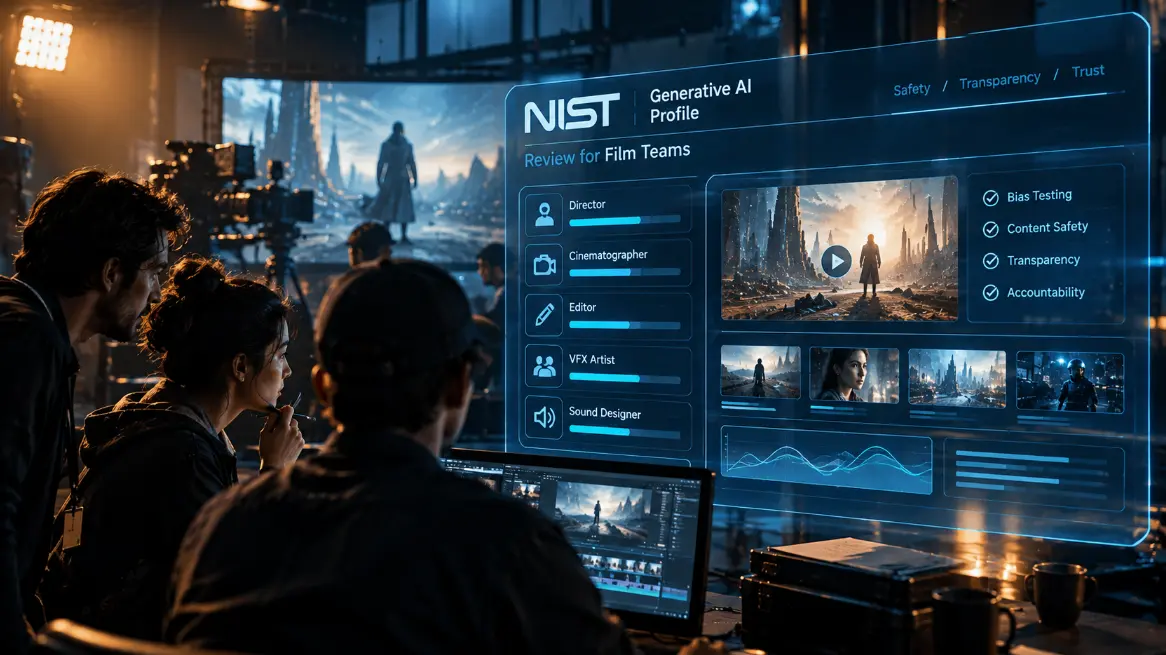
NIST Generative AI Profile offers a useful way to review AI tools before relying on them in a creative project. In this official LUMERCATCH editorial review, we examine what the July 2024 document contributes to filmmaking decisions, where its scope ends and how a small team might apply it without confusing guidance with a guarantee.
The Document Under Review
Purpose and Scope
NIST AI 600-1 is a cross-sector generative AI profile associated with the AI Risk Management Framework. It identifies risks and suggests actions for organisations managing generative AI. The document was published in July 2024; this article reviews that edition rather than claiming a newly issued report.
Why We Are Reading It
At LUMERCATCH, our interest is practical: a production team needs to know what it is approving. A visual test, a research summary and an unpublished script carry different concerns. A single statement that a tool is “safe” tells the team very little unless the task, input and review process are clear.
Five Risks Worth Translating into Production Questions
The profile discusses confabulation, data privacy, intellectual property, harmful bias and homogenisation, and human–AI configuration, among other risks. Those are the report’s categories. The following questions are our proposed application to a hypothetical production workflow.
| NIST risk category | Our production question | Suggested evidence |
|---|---|---|
| Confabulation | Has a factual claim been checked outside the model? | The original source, the checked claim and the reviewer’s note. |
| Data privacy | Are we permitted to upload this script or personal information? | Permissions, service terms and the agreed input restrictions. |
| Intellectual property | What rights attach to the references and selected material? | Asset provenance, licences and any required consent. |
| Harmful bias and homogenisation | Do generated options repeat stereotypes or flatten the design? | Alternative concepts and a documented design review. |
| Human–AI configuration | Who can challenge, revise or reject the result? | A named decision-maker and a record of approval. |
Where the Table Helps
The table separates the system’s output from the evidence needed to use it. Imagine a fictional laboratory scene. A model’s historical or scientific explanation should be checked against an appropriate source, while the art team separately assesses the scene’s look. A reference that supports a scientific fact does not automatically approve a visual asset.
Where It Needs More Work
The questions need owners. If everyone assumes someone else checked a licence or a factual statement, the record is incomplete. Our recommendation is to put each question beside the actual asset or scene it concerns. That is easier to follow than a general approval note covering the whole project.
Our Review: Strengths and Practical Limits
A Shared Vocabulary Is Useful
The profile gives a writer, designer and producer a common starting point for discussing uncertainty. In our assessment, its strength is helping a team describe the concern before choosing a response. “This output needs a fact check” is more actionable than a vague instruction to be careful with AI.
It Does Not Answer Every Film Question
A framework cannot tell a director whether a pause is emotionally right or whether a character’s reaction serves the story. Nor does reading a report demonstrate that a team has cleared all rights. Creative judgment, contracts and task-specific technical review still need their own evidence.
For authorship questions in the United States, the US Copyright Office’s January 2025 copyrightability report addresses a different question: which human expression can receive protection. That analysis should not be treated as interchangeable with NIST’s risk-management guidance.
A Small-Team Reading Method
Start with One Representative Task
Our suggested first step is to choose one task that reflects the intended workflow. Write down the purpose, inputs and acceptable result. Then use the relevant risk questions to decide what must be checked before the team accepts it. The method should be proportionate: a private visual sketch and material intended for release deserve different review decisions.
Keep the Decision Record Short
A useful record can state the asset, the source, the issue checked, the person responsible and the outcome. If the material changes, revisit the checks affected by the change. This is our proposed approach, not a claim that the profile requires this particular form or that our film followed it on every shot.
Read our guide to AI governance for the wider responsibility question, or our AI-assisted filmmaking article for the creative workflow. Our official studio introduction explains the disclosed role of human writing, AI and 3D technologies in ECHO OF THE CLONE.
FAQ: Reading the NIST Generative AI Profile
What is the NIST Generative AI Profile?
NIST AI 600-1 is a July 2024 cross-sector profile associated with the AI Risk Management Framework. It discusses generative AI risks and suggested actions for organisations.
Is this a third-party review of ECHO OF THE CLONE?
No. This is LUMERCATCH’s editorial review of a NIST document and its possible application to creative work. It is not an independent review or endorsement of the film.
Does the profile grant permission to use generated film assets?
No. A risk-management framework does not grant licences or consent. Permissions for the relevant inputs, people and assets must be assessed separately.
Are the filmmaking examples in this article taken from NIST?
No. The risk categories come from the profile. The production questions and hypothetical examples are our editorial interpretation, not a NIST filmmaking standard.
Sources and Reading Notes
- NIST AI 600-1, July 2024 — document under review.
- US Copyright Office: Copyright and Artificial Intelligence, Part 2, January 2025 — separate authorship background.
- LUMERCATCH studio introduction — official production context.
Source editions checked on October 14, 2026. The two images are conceptual illustrations, not production photographs.