
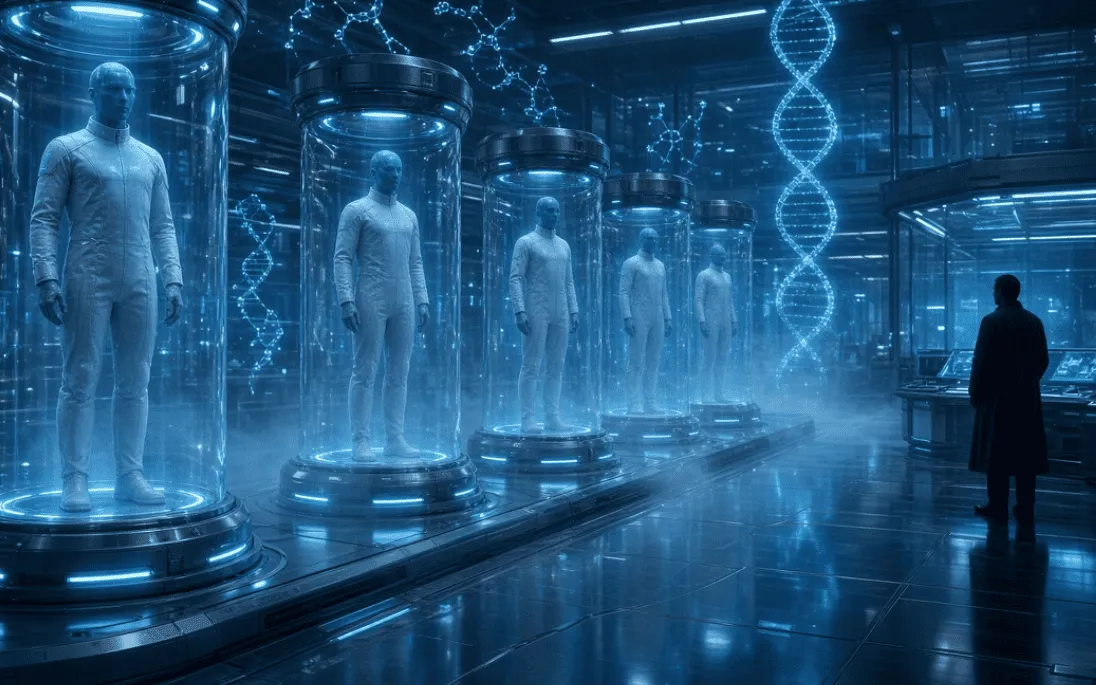
Human cloning is the idea of creating a person who carries the same nuclear DNA as someone who already exists. Despite the sci-fi headlines, no verified case of a cloned human being exists. Scientists have cloned sheep, monkeys, cattle, and cats. They’ve also created cloned human embryos in the lab to harvest stem cells. A cloned person? Not so far.
So where does the science end and the fiction begin? This guide sorts fact from fantasy. You’ll see what cloning is, how it works, what researchers have actually achieved, and why the ethics get so tangled. We’ll also look at how ECHO OF THE CLONE uses the idea. We’ll flag the moments where the film deliberately leaves the lab behind.
What Is Human Cloning?
“Clone” just means a genetic copy. Nature makes them all the time. Identical twins are natural clones: one fertilized egg splits in two. Lab cloning is different because it copies an existing individual’s DNA on purpose. Researchers usually sort it into three types.
| Type | What it copies | Main purpose | Where it stands |
|---|---|---|---|
| Gene (DNA) cloning | Genes or DNA segments | Lab research and medicine | Routine lab work |
| Therapeutic cloning | A patient’s cells, used to make embryonic stem cells | Studying disease and growing matched tissue | Research stage and debated |
| Reproductive cloning | A whole organism | Producing a living copy | Done in animals with no verified human case |
Categories follow the National Human Genome Research Institute’s cloning fact sheet.
Gene cloning is everyday lab work. Cloning a person is another matter entirely. When headlines say “human cloning,” they almost always mean the last two rows.
How Does Cloning Work?
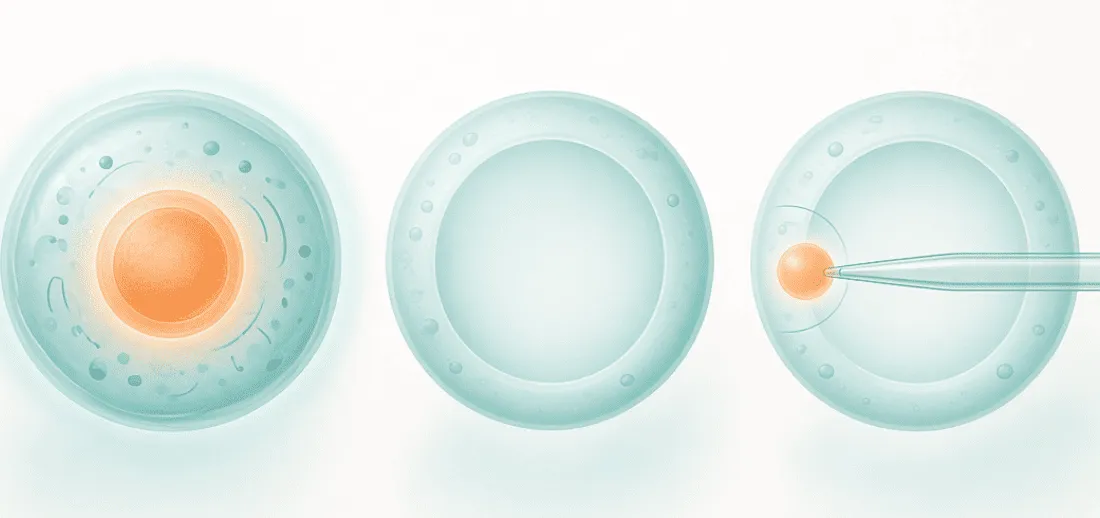
Most animal cloning relies on somatic cell nuclear transfer, or SCNT. A somatic cell is any body cell that isn’t an egg or sperm: skin, udder, liver. Here’s the basic recipe.
Pick the donor cell
Take a body cell from the animal you want to copy.
Empty an egg
Remove the nucleus from a donor egg cell. The nucleus holds most of the cell’s DNA.
Swap the nucleus
Place the body cell’s nucleus inside the emptied egg. Then coax the egg to start dividing like an embryo.
Carry to term, or stop
In reproductive cloning, a surrogate carries the embryo. In therapeutic cloning, the process stops early so researchers can harvest stem cells.
Dolly’s story shows how tricky this is. Her team used a mammary cell from a six-year-old Finn Dorset ewe and an egg from a Scottish Blackface sheep. Out of 277 cell fusions, 29 early embryos developed and went into 13 surrogate mothers. Dolly was the only lamb born. She was euthanized in 2003 after doctors diagnosed progressive lung disease.
Is Human Cloning Scientifically Possible?
Short answer: nobody has shown it. The odds look rough. Here’s what researchers have actually achieved.
| Year | Milestone | Why it matters |
|---|---|---|
| 1996 | Dolly the sheep is born | First mammal cloned from an adult cell |
| 2013 | Human embryonic stem cells made by SCNT | Cloned human embryos produced stem cells for research, not a baby |
| 2018 | Macaques Zhong Zhong and Hua Hua are born | First primates cloned by SCNT, made from fetal cells |
Three hurdles stand out.
Low success rates
Dolly took 277 attempts. In the 2018 monkey work, most of the cloned monkeys died in the womb or soon after birth, according to NPR’s coverage.
Adult cells are hard
The 2018 macaque clones came from fetal cells. The team also tried adult donor cells, which is much harder.
Real stakes
In animals, a failed attempt means a lost embryo. In people, every failure would mean a real pregnancy and a real person at risk.
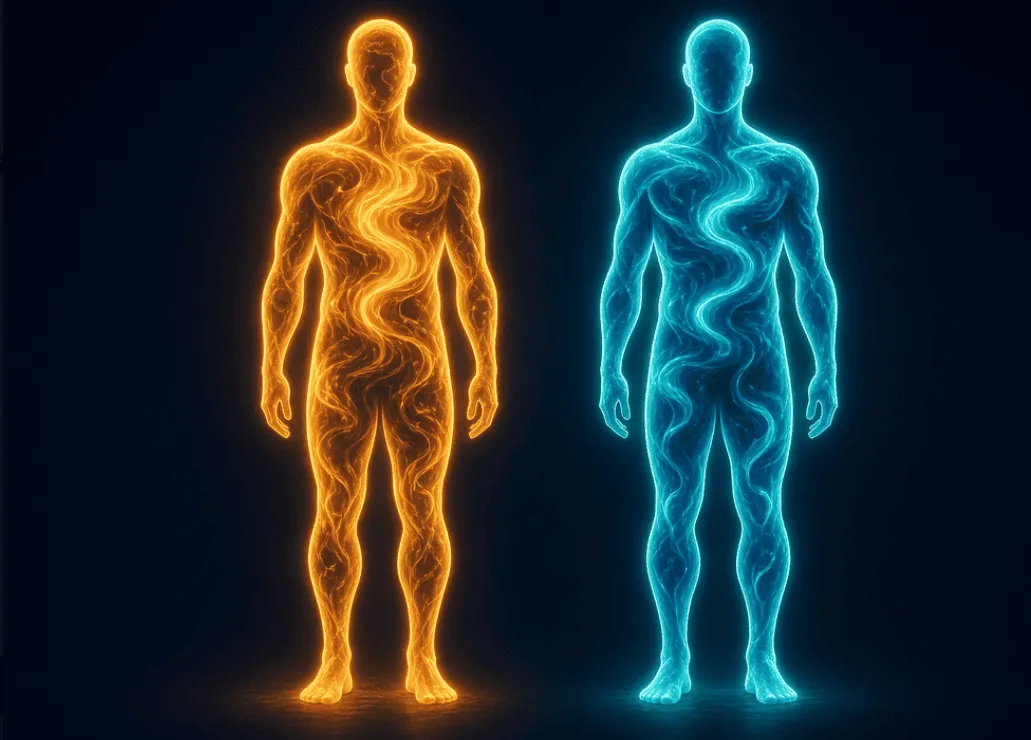
Even a technically perfect clone wouldn’t be a copy of a person. It would share nuclear DNA. It wouldn’t share memories, personality, or life story. Mitochondrial DNA comes from the egg donor. Experience shapes nearly everything else. Identical twins prove the point: they share the same DNA and still turn out as different people. A clone born decades later would grow up in a different world altogether.
Ethical Issues of Human Cloning
Even if the science were easy, the ethics wouldn’t be. Four concerns come up again and again.
Safety and consent
A clone can’t agree to being created. High failure rates make the risks even harder to justify.
Dignity and identity
The NHGRI notes that cloning humans collides with values around dignity, freedom, identity, and autonomy.
Exploitation
If people or their bodies become products, who protects them? Who profits?
The embryo debate
Therapeutic cloning creates embryos to harvest stem cells. Those who see embryos as human life object strongly. Others weigh that against possible medical benefits.
Governments and international bodies have weighed in. UNESCO’s Universal Declaration on the Human Genome and Human Rights (1997) says reproductive cloning of human beings is contrary to human dignity. Laws vary widely from country to country. Check current local rules before drawing conclusions about any one place.
Who sets the limits? That’s a governance question, much like the ones we raised in our guide to AI governance. For a deeper look at identity, rights, and consent, read The Ethics of Human Cloning.
Human Cloning in Science Fiction
Fiction gets to skip the hard parts. Nobody has to wait for 277 attempts. That freedom lets stories ask the philosophical questions first: who is the original, who is the copy, and who decides?

ECHO OF THE CLONE builds a 2127 where SC Corporation is the world’s most advanced cloning technology company. Its newest machine, Universal Mold No. 7, appears in the film’s world (you can explore it in the Cinematic Universe). The film’s worldbuilding says the machine builds on Gibson Assembly.
Here’s the science twist. In real labs, Gibson Assembly is a molecular cloning method that joins DNA fragments in a single reaction. Daniel Gibson and colleagues described it in 2009. It doesn’t make a person. The film borrows the name of a real technique and then imagines a leap no lab has made.
| Topic | Real world | In ECHO OF THE CLONE |
|---|---|---|
| Cloned humans | None verified | Clones exist in the 2127 setting (fiction) |
| Clone and original | No established evidence of a physical link | A strange biological connection drives the mystery (invented) |
| Gibson Assembly | Joins DNA fragments in a test tube | Named as the basis of Universal Mold No. 7, a machine imagined to go far beyond that |
| Purpose | Research, agriculture, conservation | Medical cloning, a black market, and a social debate |
The story isn’t really about copying a mind. When a corporate CEO named Catherine notices something wrong in her own body, she starts digging. Mike, one of the machine’s original designers, holds part of the answer. Illegal clones made without consent are a crime in the film’s world. The film doesn’t excuse them.
Director Chalim Huang describes the cloning technology as a mirror. The same tool can serve crime and exploitation. Once legal, ethical, and safety boundaries exist, it might become a social option instead. He leaves it to viewers to decide whether that answer is sound or dangerous.
Want more? See how other stories handle the theme in Human Cloning in Sci-Fi: Stories, Ideas, and ECHO OF THE CLONE.
Where Could Cloning Go Next?
Nobody can say for sure. A few trends are visible. Researchers still use SCNT in animal studies and stem cell work. Some labs now turn to induced pluripotent stem cells, which reprogram adult cells without creating a cloned embryo, to chase similar medical goals.
Reproductive human cloning faces broad opposition and unsolved technical problems. Any future debate will hinge on safety, consent, and what we think a person is. Those questions will matter long before the technology does.
FAQ: Human Cloning
What is human cloning?
Human cloning is the creation of a human being, or of human cells or embryos, that carries the same nuclear DNA as an existing person. Researchers separate it into gene cloning, therapeutic cloning, and reproductive cloning. Only the last aims to produce a whole person. No verified case exists.
Has a human ever been cloned?
No verified case of a cloned human being exists. Researchers have created cloned human embryos to obtain stem cells. They first reported that in 2013. Earlier claims of cloned human embryos, including one from South Korea in 2004, turned out to be false.
Is human cloning scientifically possible?
In theory, maybe. In practice, nobody has shown it. Cloning other mammals still has low success rates, since Dolly the sheep was the only live lamb from 277 attempts. Human reproductive cloning would also raise serious safety and ethical problems.
Would a human clone be identical to the original person?
A clone would share nuclear DNA with the original. It wouldn’t share memories, personality, or life experience. Mitochondrial DNA comes from the egg donor. Environment shapes who a person becomes. Identical twins share DNA and still grow into different people.
What is the difference between therapeutic and reproductive cloning?
Reproductive cloning aims to produce a whole living organism, such as Dolly the sheep. Therapeutic cloning creates embryonic stem cells from a patient’s cells so researchers can study or grow matched tissue. The embryo is never meant to develop into a person, though the debate over using embryos this way is heated.
How does ECHO OF THE CLONE treat human cloning?
The film imagines a 2127 world where a company called SC Corporation leads the field in cloning technology. It treats illegal cloning as a crime and uses the technology as a mirror for bigger questions about loneliness, consent, and social responsibility. The film’s clones and the mysterious link they create with their originals are fiction, not science.
Step Into a World Built Around These Questions
If the science-versus-fiction question fascinates you, the film puts it on screen. Explore the story, the world, and the people caught in it.
About the Film Cinematic Universe Meet CatherineKeep Reading
The Ethics of Human Cloning: Identity, Rights, and Morality
Consent, individuality, and whether a clone would have the same rights.
Human Cloning in Sci-Fi
Why stories keep returning to clones, memory, and identity.
AI Governance: Who Should Control Artificial Intelligence?
Rules, oversight, and the human judgment machines can’t replace.
Sources and further reading
- National Human Genome Research Institute, Cloning Fact Sheet.
- Britannica, Dolly (cloned sheep).
- University of Edinburgh, Cloning of Dolly the Sheep, 1996.
- Animal Research Info, Cloning Dolly the sheep.
- Liu Z. et al., Cloning of Macaque Monkeys by Somatic Cell Nuclear Transfer, Cell, 2018.
- NPR, Chinese scientists clone monkeys using the method that created Dolly, 2018.
- National Academies, Scientific and Medical Aspects of Human Reproductive Cloning.
- Gibson D. et al., Enzymatic assembly of DNA molecules up to several hundred kilobases, Nature Methods, 2009.
- UNESCO, Universal Declaration on the Human Genome and Human Rights, 1997.
Film details come from official ECHO OF THE CLONE materials. This article is general information, not medical or legal advice.